Friday, June 08, 2007

Christ Followers in KiasuLand

Have you met any "kiasus" ( Hokkien word to describe someone who is afraid of losing) recently? It's really easy to spot one. Some characteristics of "kiasus" are:

Their favourite words are "Me", "Myself", "Mine" and "I" in big bold capital letters.

They make choices solely on the basis of what benefits them the most.

They are resistant to the fact that anyone can be better than them.

They want to win at all cost, even willing to sacrifice integrity, relationships and health at the altar of success.

If you have problems finding a "kiasu", let me tell you a place where you can likely find one. Look at the mirror! Jab! Jab! Ouch! That's painful, isn't it? But it is so terribly true. Let's admit it. We live in a "me" era. However, many of us are sophisticated enough to mask our "kiasuism" with subtle packaging. Our pride is called ambition. Our greed is named "hunger for growth". Our seeking for fame and popularity is hidden under the veneer of "marketing our talents and skills".

Don't get me wrong. I am not anti – growth or anti- competition.

Godly stewardship of our marketplace position entails a strong focus on productivity, growth and profitability. However, my concern is that we may focus entirely on self interested motivations and on winning at all cost that we end up being another "kiasu" in kiasuland. Surely, our calling as marketplace Christians should compel us to see beyond salaries, profitability and increasing of
market share.

Laura Nash in her book "Believers in Business", noted a covenantal approach among some evangelicals to the competitive drive in business. In a covenantal approach, the first question asked is not, How much money did we make? but How is the customer faring? In other words, the primary purpose of Christians in the marketplace is the creation of value for others. In Philippians 2 v 4, the Bible said, "Let each of you look not only to his own interests, but also to the interests of others." That seems to be a value creating call to me. And, it is also a warning against "kiasuism".

I'll end with some questions on how we can create value for others:

In your workplace, what does it mean to be more of a giver than a taker when it comes to adding value to your organization?

Is your organization a better place to work because you are on the payroll?

If Christ were to have your job, how would He create value for your bosses, peers, subordinates, clients and society at large?

As Christ followers, let's focus on creating value for others. It's the antidote to being a self seeking "kiasu".

Wong Fook Meng
Graduate Christian Fellow i-Commentary

Tuesday, June 05, 2007

Inconvenient Truth: Global Warming


Elder Kee Huat was the Director of National Energy Commission, which provided him a unique perspective into the issue of global warming and creation care. Last Sunday, he gave an informative and passionate plea for action to the Church.

The Powerpoint slides would provide some research data he compiled, painting a grim picture of current situation that requires our response. Towards the end, he gave a Christian response similar to the Creation, Stewardship sections of the Lausanne Evangelical Commitment to Simple Lifestyle document.

He also draws resources from Richard Foster's Discipline of Simplicity for personal application:
"The inward reality of simplicity involves a life of joyful unconcern for possessions. Neither the greedy nor the miserly know this liberty.

If what we have we receive as a gift, and if what we have is cared for by God, and if what we have is available to others, then we will possess freedom from anxiety.

However, if what we have we believe we have got, and if what we have we believe we must hold onto, and if what we have is not available to others, then we will live in anxiety."


What are some outward expressions of Simplicity?

- Buy things for their usefulness rather than their status.
- Reject anything that is producing an addiction in you.
- Develop a habit of giving things away: de-accumulate
- Refuse to be duped by gadgetry: time saving devices almost never save time.
- Learn to enjoy things without owning them: beach, parks public libraries...
- Develop a deeper appreciation for creation. Walk whenever you can, smell the
flowers, watch birds.
- Develop plain simple talk.
- Reject anything that breeds the oppression of others.
- Shun anything that distracts you from seeking first the Kingdom of God.

Tuesday, May 29, 2007

Resurrection In Each Morning

We dont usually remind ourselves of who we are when we wake up every morning. We dont really need to remind ourselves of our name, address, mobile number. We dont do that unless we are suffering from some kind of memory-loss disease. Those who have watched Momento will be reminded of the memory-lost protagonist who had his body tatooed so that he will know what he should do in each day.

Do Christians need tatoos to remind ourselves of our identity?

We might had weird and un-Christian dreams over the night or there are armies of sub-human desires and visions charging towards us when we gain our consciouness each morning. Do we jump off the bed, kneel down and ask for forgiveness and strength? Usually we dont. We just dont take those early desires and visions seriously because we know those are of our carnal, fleshy, fallen nature. But on the dark side, we tend to keep-safe these demons. Can't we have a break? Why such dreadful angelic war in morning?

Anyway, it is our own choice whether to struggle or to give in. The ideal is that the moment we ignore them, push them away, we are just about to start our day. And we have to keep doing this for most morning in this short period of living. Is that it? No, not that simple. Each action that we take bear more and deeper meaning than we usually know. By prayers and struggles, we are reminded of who we are, not by our name but by our personhood. When we wake up, we exercise our personhood to identified ourselves with the death and resurrection of Jesus. When we slept, we died, when we wake up, we resurrect.

In this way, each morning is a resurrection morning. We woke up with our resurrected identity. We dont need tatoos! All we need to do is to push the tomb stone away. Yes, push the carnal dreams, desires, and visions away.

Each morning, we know not only our name, address and mobile number, but also our personhood. With that, we walk out of our bed as Jesus walk out from the tomb, continuing the work the resurrection had inaugurated.

So, good morning.

Tuesday, May 22, 2007

Two Paths Of Obedience

Two Paths Of Obedience by Dr Goh Chee Leong, an article written for Graduate Christian Fellowship

I think all of us as Christians agree that our responsibility above all things is to follow where God leads us. We all believe in divine guidance, even though they may be differences in how God chooses to communicate this guidance to us. The more difficult challenge of course is not discerning His will but having the strength to submit to His call when it is revealed.

We realize of course that God's calling will lead all of us in different directions. Some may be called to take the path of upward mobility while others will be called to head south.

The Path of Upward Mobility

There are ample examples in the Bible of God placing key people in key positions. Both the stories of Daniel and Joseph provide good models of God developing young leaders and then empowering them to wield Godly influence at key moments in history. Many sermons have
been preached on the need for committed Christians in positions of leadership in all areas of society and industry. God's name is glorified when his servants of high profile reflect His attributes of love, grace, holiness and integrity.

Some among us may be called to this high road of power and influence. Of course, men like Joseph and Daniel never sought power as an end; rather they pursued righteousness and received power quite unexpectedly as a result of God's provision. As their examples
demonstrated, God will tests these potential leaders and only give them power when they have proven faithful and obedient in the smaller tasks. He does this for good reason, for power and wealth, as we know, corrupts.

God has blessed some of us with talents and gifts of intellect that will no doubt enable us to climb the corporate and social ladder as far as we wish to go. We work hard and are committed to transcend mediocrity. This success is not a bad thing in itself, for God may indeed have designs to use us as leaders and people of influence and power. However, those who are called to this high road thread a dangerous path indeed. Many have lost their souls trying to serve both God as well as their personal ambitions. There is a fine but clear line between being driven by a desire to obey and being driven by the desire to succeed. Mother Theresa once remarked; "God has not
called me first and foremost to be successful. He has called me to be faithful."

The young Christian graduate who sets out with the genuine desire to earn wealth in order to support God's kingdom may at some point be so obsessed with achieving his goal that he forgets the motive behind it. This moral tension becomes more apparent when faced with ethical
dilemmas that pit following God versus corporate success.

I recently remarked to a college CF that we should start inviting more speakers who have the experience of being held back or fired from their jobs because they chose to follow God rather than their own ambitions. We should remember that Joseph was held back for quite awhile in his "political career" (due to his faithfulness) before he rose to the lofty positions he finally held.

The Path of Downward Mobility

It was Henri Nouven who taught me the phrase downward mobility. His own life of course reflected this thinking. A famous professor of theology at the peak of his academic career at an ivy league university, Nouven heeded God's call to abandon all fame, fortune, power and influence to serve as a Priest to a mentally disabled community for the remainder of his life. God had called him not be upwardly mobile but like Christ to lower himself in the eyes of society so that he could be closer to God.

Some of us will be called to walk this road of downward mobility. It will lead us away from the limelight and places of profile to the quiet corners of this world where God's plan is no less important. It will lead to sharp drops in the key performance indicators (KPIs)
that are used by this generation to measure success. People while openly stating their admiration for our commitment will behind our backs quietly remark "what a waste of talent."

This is the path of John the Baptist, the old-testament prophets like Jeremiah and Isaiah, and most of the apostles like Paul and Peter. It is the path of missionaries, social workers and Christian workers. It is a call to free ourselves from the wealth and position that so
often limits mobility and time. It is not the road reserved for those who cannot "make it" up the upwardly mobile path, it is certainly not the consolation prize for those who lack talents to succeed in other professions. Some of us are called to this path simply because it is
God's will and part of God's larger design.

Conclusion

The Kingdom of God needs young men and women in both these paths; the one that leads to high profile leadership and the other that leads down the social ladder. God places equal emphasis on each. There is no thought of which is greater than the other. As Paul remarks, we
have been given different gifts in order to play different roles.
All roles are important in God's church.

The question is whether we are on the path God has called us to, and if we are, are we being faithful in playing the role God wants us to play.

Dr Goh Chee Leong

Thursday, May 17, 2007

Money Not Enough

GCF i-commentary: In 1998, Jack Neo released his popular movie, "Money Not Enough" during the throes of the financial crisis. Whether or not one has watched the movie, the title will strike a chord with many of us at one time or another.

The price of almost everything is going in only one direction: UP. Things are getting more expensive these days, from food items to petrol and even to ASTRO bills (ASTRO has become almost a basic necessity for some of us). If only Christians can buy lottery tickets and have a shot at the jackpot. All of us can use some extra cash (just kidding).

The Bible has a lot to say about money matters. In 1 Timothy 6 v 6, the Bible says that "godliness with contentment is great gain".

Contentment is a famous lost word. In a culture where novelty has become a norm, all of us have to struggle against the lie that "bigger, newer and faster are better!" We are bombarded with constant advertising from all over the place telling us that our life is not complete unless we live in a bigger house and drive a fancier
car and invest in that high yielding portfolio. Contentment? That is something reserved for mystics who spend their days meditating in caves, not for urban dwellers like us who have a "modern standard of living" to maintain. Yet, we all know the well worn phrase, "things cannot buy happiness". Still, we yearn for more stuff that this world can offer, always chasing that elusive fulfillment that the next purchase may bring.

This quote from Herbert Schlossberg stopped me in my tracks recently: "All true needs, such as food, drink, and companionship, are satiable.Illegitima te wants - pride, envy, greed - are insatiable. By their very nature they cannot be satisfied. In that sense, materialism is the opium of the people. Enough is never
enough. Greater quantities are required for satisfaction and each increment proves inadequate the next time."

After reflecting on this quote, I resolved to be a more contented person and focus on legitimate needs. I realized afresh that I do not really need much stuff to get by in this life. True needs are satiable. I can eat a simple plate of "chap fan" and be truly satisfied. I can drink local "kopi O" instead of splurging on a RM10
coffee to quench my thirst. I can drive my wife's Kelisa and reach my destination (since when does transportation become a symbol of success?). When life is simple and we are freed from the tentacles of materialism, we can focus on finding true fulfilment and satisfaction in a growing and vibrant relationship with Christ. It's true that money is not enough. All the money in the world is not enough to give
us a sense of purpose and direction in life. Only Christ can do that.

When we have Christ and we learn to live simply and contently, that is great gain!

Christ is Enough,
Wong Fook Meng

Christianity and Word Religion/Culture


2007 Reformed Evangelical Seminar,Singapore
Christianity &World Religion and Culture

Dates :
17 May 2007 (Thursday) 7.30pm-10.00pm
18 May 2007 (Friday) 7.30pm-10.00pm
19 May 2007 (Saturday) 6.00pm- 8.00pm (5.00pm-6.00pm Q &A)
20 May 2007 (Sunday) 7.30pm-10.00pm

Speaker : Rev Dr Stephen Tong
Interpreter : Elder Yong Teck Meng (Mandarin with English Translation)
Location : Newton Life Church, 200 Keng Lee Road, S30841o

Thursday, April 26, 2007

Statement of Faith

We believe in...

1. The one true God who lives eternally in three persons—the Father, the Son and the Holy Spirit.

2. The love, grace and sovereignty of God in creating, sustaining, ruling, redeeming and judging the world.

3. The divine inspiration and supreme authority of the Old and New Testament Scriptures, which are the written Word of God—infallible and fully trustworthy for faith and conduct.

4. The dignity of all people, made male and female in God's image to love, be holy and care for creation, yet corrupted by sin, which incurs divine wrath and judgement.

5. The incarnation of God's eternal Son, the Lord Jesus Christ—born of the virgin Mary; truly divine and truly human, yet without sin.

6. The atoning sacrifice of Christ on the cross: dying in our place, paying the price of sin and defeating evil, so reconciling us with God.

7. The bodily resurrection of Christ, the first fruits of our resurrection; his ascension to the Father, and his reign and mediation as the only Saviour of the world.

8. The justification of sinners solely by the grace of God through faith in Christ.

9. The ministry of God the Holy Spirit, who leads us to repentance, unites us with Christ through new birth, empowers our discipleship and enables our witness.

10. The Church, the body of Christ both local and universal, the priesthood of all believers—given life by the Spirit and endowed with the Spirit's gifts to worship God and proclaim the gospel, promoting justice and love.

11. The personal and visible return of Jesus Christ to fulfil the purposes of God, who will raise all people to judgement, bring eternal life to the redeemed and eternal condemnation to the lost, and establish a new heaven and new earth.


Agora Singapore's Statement of Faith is the expressed core beliefs of the group. This Statement serves the purpose of directing the group along its vision and function as ambassador, witnessing to both the people of God and pre-believers. This revised Statement of Faith is adopted from the Evangelical Alliance.

Monday, April 23, 2007

Intelligent Design: Science or Faith


An Open Forum

Panelists: Prof Guillermo Gonzalez, Dr Jay Richards,
Prof K.O Lee, Mr LT Jeyachandran
Moderator: Dr Lawrence Chia
Date: 24th May 2007, Thursday
Time: 7.30pm
Venue: St. Andrew's Cathedral, 11, St. Andrew's Road


A Public Meeting: Darwinianism & Intelligent Design
Speaker: Dr Jay Richards
Date: 25th May 2007, Friday
Venue: St. Andrew's Cathedral, 11, St. Andrew's Road


Guillermo Gonzalez is an Assistant Professor of Astronomy at Iowa State University, He received his Ph.D. in Astronomy in 1993 from the University of Washington. He has done post-doctoral work at the University of Texas, Austin and at the University of Washington and has received fellowships, grants and awards from such institutions as NASA, the University of Washington, Sigma Xi (scientific research society) and the National Science Foundation.

Dr. Gonzalez has extensive experience in observing and analyzing data from ground-based observatories, including work at McDonald Observatory, Apache Point Observatory and Cerro Tololo Interamerican Observatory. He has also published over sixty articles in refereed astronomy and astrophysical journals including Astronomy and Astrophysics, Monthly Notices of the Royal Astronomical Society, Astrophysical Journal and Solar Physics. His current research interest in astrobiology focuses on the "Galactic Habitable Zone" and captured the October 2001 cover story of Scientific American.

Jay W. Richards is Vice President and Senior Fellow of the Discovery Institute in Seattle. He received his Ph.D. with honors in philosophy and theology from Princeton Theological Seminary, where he was formerly a Teaching Fellow.

He is the author of many academic articles, popular essays, and op-eds, on topics as diverse as science, philosophy, and theology. He is editor and contributor, with William A. Dembski, of Unapologetic Apologetics: Meeting the Challenges of Theological Studies (InterVarsity Press, 2001), editor and contributor with George Gilder of Are We Spiritual Machines?: Ray Kurzweil vs. the Critics of Strong AI (Discovery Institute Press, 2002), and author of The Untamed God: A Philosophical Exploration of Divine Perfection, Immutability, and Simplicity (InterVarsity Press, 2003).

Thursday, April 19, 2007

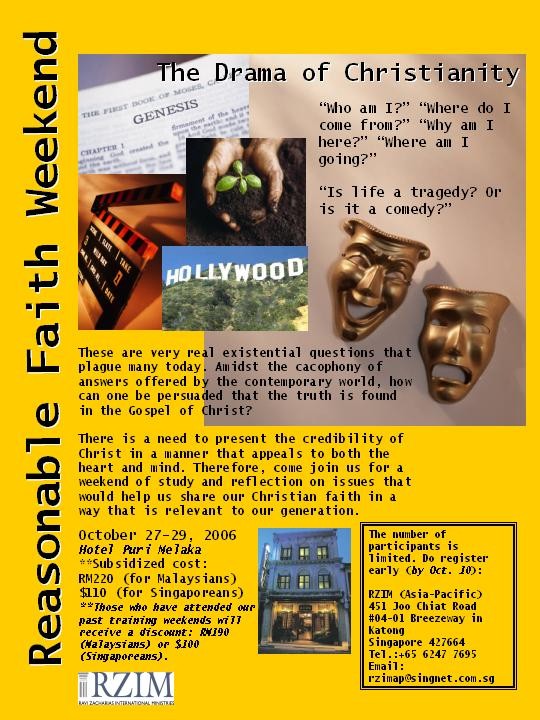
RZIM Reasonable Faith Conference 2007@Melaka

Question: Who are we?

Answer: We are people of God who were on our way to Melaka(!) for RZIM's Reasonable Faith 2007 conference on 13th April 2007.

Question: Er...... i mean the names of those that went to Melaka...

Answer: Ohh... Joshua Woo, Benjamin Ho, Darren Chow, Howard Zhen Hao, Mejlina, Joanne Yap, Serene Huang, God the Father, God the Son, & God the Holy Spirit.


Question: Where were we?

Answer: At first, we were at Arab Street bus terminal. At about 8am, the bus took off from Arab Street bus terminal to Tuas second link. Then the Immigration checkpoint. First the Singapore checkpoint, then the Malaysia checkpoint, then the bus stopped at a rest-station for the passengers to relief themselves a little before going on to....


Question: er.... i mean where were we when these pictures were being taken...

Answer: Ohh... we were in the bus....Everybody were enthusiastic and energized. Some were chatting, some were reading, some was taking pictures...some were...well...sabbath.

As Darren was busy following all the lyrics from his MP3 player, Mejlina was busy sharing her enriching experiences with Howard Zhen Hao. On the other seats, Joanne was too caught up reading Zoe Tay's second pregnancy while Serene was meditating with her eyes closed, in a lotus position.

Anyway, after 4 hours of sitting still and trying our best at controlling ourselves from the 'shoes-throwing games' in the bus, we managed to reach safely at about 11.30am.

At Melaka Sentral, autonomously, we spilt roles and responsibility. Howard Zhen Hao and I went to look for return tickets to Singapore while the rest look for lunch venue. After enquiring all the ticketing counters, thank God, we managed to get the tickets!

On their side, they managed to find an A&W restaurant. Too bad, i didn't take any picture there.

After lunch, we took 2 cabs to Hotel Puri. Darren, Mejlina and me got into one, while the rest had to squeezed themselves into another. The journey from Melaka Sentral to the hotel took us 10-15 minutes. This is the hotel main entrance.

TADAAAAAAAAAAAAAAAAAAAAAAAA!!!!!!!!!!!!

Ok... that's Howard Zhen Hao. This is his first time joining RZIM's conference, so please be patient with his enthusiasm.

After cooling himself down, Howard Zhen Hao joined in the queue to register and settle the payment for the conference. Total cost for the conference is SGD 160. And that includes accomodation, meals, and a RZIM's file!

The lady in pink is Dorothy and the gentleman in green is Brian. Mejlina was so happy that she couldn't stop smilling. Guess she was very happy to have arrived at the long anticipated conference.


After settling all those important paperworks, all of us were assigned to our rooms. I got Ben to be my roomate for the weekend. That means besides apologetics, postmodernism, existentialism, pluralism, philosophy of science, movie criticism, historical Jesus, Islam, and where to have the Melaka chicken rice, we learnt how to live with one another (especially how to cover your ears when your roomate snores).

The room was nice. It's clean and......... well, clean.


These are the toiletries. As i had guessed, the hotel provides 2-in-1 shampoo and conditioner. It's convenient to use because you can shampoo and condition your hair at the same time.

Question: What? At the same time? Huh.. you mean you used 2-in-1 shampoo conditioner?

Answer: Yes, why?

Question: AHHH idiot! Shampoo are negatively charged and dries up hair by removing the positive charges, dirt, and oil. Conditioner is positively charged and moiturizes. How can the lotion be drying up and moisturizing your hair at the same time?

Answer: *grasp*.. ok... no wonder the frizzly hair..but I had no choice. I didn't bring my own lotion.

Anyway, let's move on. Life is more than having healthy hair... So after resting for 30 minutes or so, the conference started with an opening ceremony. I'Ching gave us a preview of the 3 days, 2 nights conference and LT introduced the speakers (philosopher Stuart McAllister and historian John Dickson) and talked a little bit (I'm sure LT can go beyond the mere 1 hour 15 mins) on the whole idea of conference's title 'Jesus Among Other Lords'.

After that, we had our 1st Bible studies session on the book of Ecclesiastes. Stuart had us amazed with his profound skill of fusing existentialism, postmodernism and the message of Ecclesiastes to bring out the idea of evangelism and apologetic in current cultures.

After that BS session, it was workshop time! I'd chosen to join I'Ching's Communicating Jesus In Pluralistic Society workshop. She facilitated the group well and had us discussed and shared among ourselves the struggles and problems that we faced in evangelism and apologetics. I raised a question on one of her passing remark. She said that the existence of evil and suffering is an indication for the existence of God. My question was, how is that so? She answered briefly. Briefly not due to her lack of comprehension but because the topic is too big to be confined within a few minutes of sharing. Thus yesterday, when i visited RZIM office to collect the conference receipts, she commended Douglas Geivett's Evil & The Evidence For God to my reading. I grasped when i found out that it's published by Temple University Press. (i grasped even as i'm typing this).

After the workshop, we had our break and guess what, it's dinner time. Here is the picture of the place we had our breakfast, lunch, and dinner.

All meals are buffet-served. I had lots of watermelon, papaya, and honeydew during that weekend because need those vitamins to sustain myself as healthy and as heuristic as i can.

After dinner and rest we get to relax a bit through the movie and discussion session. They showed existentialist Ingmar Bergman's The Devil's Eye. Finally i know who is Don Juan.

After the movie, Darren, Mejlina, Ben, Howard, and I went out to stroll around the night scene in Melaka. Nothing much to do and nothing much to see. We just spent our time at the night market.

The next morning, we had Stuart to lead us in the 2nd session on the book of Ecclesiastes. After that, John Dickson took over the conference for his session. His led us to examined the identity of Jesus Christ by historical approaches. Though the presentation seems to be down-to-earth 'historical' and not philosophical at all (because it lacks 'philosophical terms' such as trinitarianism & etc), but to those who are aware, the entire project of historical quest for the real Jesus is no less philosophical, if not more. Methodologies, philosophical assumptions, and hermeneutics proper are the 'undersea cables' in this project.
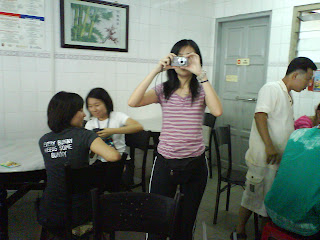
During lunch time, i dont know whose idea was it to have Melaka chicken rice. So the group went out to town and walk about 10 minutes to reach this restaurant. While waiting for the chicken and the rice, we took pictures. This picture is when Mejlina is taking the group's photo. Oh yea... Dave Chong had just arrived to join us for lunch.

We were surprised when we find out that our drinks weren't served, by the restaurant's employee but by someone from another restaurant. Do u see what's going on? This is 'Outsourcing'! The restaurant has outsourced its beverages business!

Check these out: Fish ball?? Sotong ball?? Beef ball?? Prawn ball?? Or pork ball??

NO, NO, NO, NO, NAY

It's RICE ball!!! Yes, i was as shocked as you (referring to those who are shocked) when i found out. I thought these were fish ball and i kept waiting for my rice to be served until Joanne and Serene enlightened me.

After lunch, the Agorians head back to the cafe in the hotel for a management meeting. We discussed stuffs that have been hovering over our minds since the past week. Dave started the meeting with the vision and focus of the group, while we were holding our tongues in waiting for him to finish so that we can have our turn. The meeting went well. Settled most of the major issues.

Next we head for workshop. I went for John Dickson's Islam-The Truth Behind The Headlines. He presented clearly the Islamic view of Christianity and those unjustifiable caricatures made by Christians on Islam. He went on to teach us how to dialogue and have casual talk with Muslims about Christ.

After his workshop, i went to LT's Spirit of Science. He facilitated the group into thinking about the enterprise of science, from pre-modern to modern. He had us examined some of the philosophical assumption underlie sciences.

Before dinner, there was a session by I'Ching. Her interesting sharing titled "Happiness: Mastercard or Visa".

After came out from the conference room, we began to be aware of the underlying philosophies of advertisements and commercial marketing tactics. To think about it, the current cool 'trend' is nothing more than the projections of some marketing genuises into the society. They manipulate humans' desires and longing to make us products-driven.

In the evening, after dinner, we watched another movie. This is a good one. Really a good movie! After the movie, we hang out at the hotel's lounge, talked until 12.20mn. Was tired. No wonder felt some fatigue at times in the weekend. But it's alright. Nothing is better than laughing, joking, and sharing with friends. After that, the Singaporean Agorians took this picture at the corridor.If you dont know who is who, figure out yourself.

After that, we laid our tired shells to rest. Before i knew it, my mobile's alarm rang. The last day of the conference...

We had our final session on Ecclesiastes after our breakfast, followed by John Dickson's Jesus Then & Now before lunch. Then another session by John on Pluralism and Christian faith titled 'Religion Roulette: How Can We Know For Sure?' before the closing session.

The conference ended at about 3.30pm. Everyone was exchanging emails and contacts. Everyone was heavy-hearted to come to the end of the enriching conference in that warm afternoon. Group photos were taken to be kept down the memory lane :)

More pictures here

Tuesday, March 27, 2007

T-Chat: Theology Proper 2 download

Here's the recording of the recent T-Chat session by LT (2nd session) for those who weren't there.

Click here to download. (you'll be directed to a page where u need to enter the verification numbers at the top right hand corner, after that just wait for a while and it will start to download.)

Thursday, March 22, 2007

Samuel Ling - " Who Are We? The Christian's Identity " MP3 Download


For those who are unaware, Dr Samuel Ling was at the the reformed evangelical fellowship in Singapore last saturday and gave a very important talk on the Christian's identity. Highly recommended!

Download Here


Monday, March 12, 2007

Lenten Public Lecture: The Resurrection of Christ

Lenten Lectures by Dr. Tan Kim Huat, Chen Su Lan Professor of New Testament and also the Dean at the Trinity Theological College. In addition to his many scholarly interests (the chief of these being the subject of the emergence of Christianity within a Jewish matrix), he is concerned with the struggles and issues faced by ordinary churchgoers.

Date:
14 March : Is This All There Is To Life?
21 March : The Dawn Of A New Age : The Resurrection of Jesus Christ
28 March : Transforming The World : Pauline & Present Perspectives Of The Resurrection

Time: 8.00-9.30pm

Venue: Kampor Kapor Methodist Church, 3 Kampong Kapor Road, Singapore 208676

T-Chat: Attributes of God

The Attributes of God

Is God eternal? Is God all-good? Is God all-knowing? Is God all-present?

T-Chat is a theological chit-chat session among lay Christians with the interest to know and explore more on different aspects in Christianity

Date: Wednesday, 14 March 2007
Facilitator: Dominic Foo

Time: 7.30- 9.30pm
Venue: Orchard Road Presbyterian Church (3 mins walk from Dhoby Ghaut MRT)
Cost: Free
Contact person: Joshua 92366672


*Those who have, please bring along Alister McGrath's Christian Theology: An Introduction.

Wednesday, March 07, 2007

James M. Houston Public Lecture

The Paraclete* & The Role of Christian Mentoring Today

Speaker: James Houston, Board of Governors' Professor, Spiritual Theology. MA (Edinburgh), MA, BSc, DPhil (Oxford)

Venue: Sancturay, Zion BP Church, 4, Bishan St 13, S(579792)

Date: 7 April 2007 (Saturday)

Time: 7.30-9pm

Admission is free

Prof. James Houston spent more than 23 years as lecturer and fellow at Oxford University in the discipline of the history of ideas and historical geography. He was also the founding Principal of Regent College (Vancouver), and later Professor of Spiritual Theology. Now retired, he is at present working in collaboration with Prof. Bruce Waltke on a commentary and history of the exegesis of the Psalter.

Public Lecture source

Regent College faculty list

*Paraclete is Holy Spirit in Greek

Sunday, March 04, 2007

The End Of The World In Christianity And Other Religions

The End Of The World In Christianity And Other Religions

Time: 6.30-8pm
Venue: YMCA, Function Room 1, Level 4
Date: 15 March 2007, Thursday
Speaker: Rev. Ng Koon Sheng

Friday, February 23, 2007

Reasonable Faith 2007 (RZIM)

Reasonable Faith Training Program

Date: April 13 - 15, 2007
Venue: Hotel Puri Melaka, Malaysia
Contact: iching@rzimap.com.sg (IChing) for more details abt registration

Exciting and Relevant Issue: "Jesus among other lords"

The experienced RZIM team will take you on a discovery exploration on Religion roulette: How can we know for sure?, Interactive Movie Discussions, Worldview thinking, How now shall we live?, Postmodern spirituality, Jesus then and now, Ecclesiastes, Communicating the gospel in a pluralistic society and so much more!

Without a firm foundation in Scripture and the uniqueness of Christ, we would risk being captivated by religious pluralism and postmodern spirituality which reduced the gospel narrative as merely one among many religious options in the supermarket. I highly recommend this camp to everyone!

Friday, February 16, 2007

What Would Jesus Think?

Presented a message on "How Would Jesus Think"? to the Christian Fellowship in Universiti Malaya... Here's the long version:


What is WWJD? Wikipedia: “A personal motto for thousands of Christians who used the phrase as a reminder of their belief that Jesus is the supreme model for morality, and to act in a manner of which Jesus would approve”.

Today, I’d like us to consider a new question: “What Would Jesus Think?” (WWJT)

He is Lord of our hearts, minds and strength, the supreme model for our thinking habits. Look at examples of how Jesus used His mind in the Gospels and see how that is relevant to our own questions.

Why is it important?

When was the last time you were encouraged to think Christianly as a student of law, business, information technology or education? Demonstrate the Lordship of Christ in all things.

If we don’t think after biblical perspective in our areas of study, two results happen

1) “Faith is believing what you know ain’t true?” (Oscar Wilde) If there are reasons or proofs, where is the room for faith? If got faith, why need reasons?

Biblical faith is beyond reason, but not against reason. It is not blind faith or intellectual suicide. Faith involves knowledge, agreement and personal trust/commitment.

2) No Impact On World Outside: “Christian on Sunday, Functional Atheist on Monday”

”God defines worship as the offering of one's total life to Him, a commitment to obey Him in every sphere of life including formal public worship. Elaborate formal worship without the worship of one's total life was not acceptable.” - Tan Soo Inn

Is the gospel just otherworldly? Or Is it also relevant to every dimension of human existence – spirit, mind, body, economics, politics etc in THIS world?


How Did Jesus Do It?

Look at how Jesus used His mind in conversations with those who ask. Don’t be just an answering machine. Be a good listener. Ask good questions like Jesus to open up assumptions, clarify information, and make people think. Thinking is not our enemy.

Jesus’ purpose of using logic is not to win debates but to open up minds, not force conclusions down hearer’s throats but to let them discover the truth themselves!

Some Examples

1) The Loaded Question in Luke 20: “Should Christians pay taxes or not?” Giving the right answer to the wrong question (loaded with wrong assumptions) is always wrong.

Application: Is abortion wrong? What are the cultural assumptions behind it?

2) The False Dilemma in Matthew 22:37: “Women With 7 Husbands In Heaven?”
What are the possible answers Jesus could have given? (offer a third way) Why didn’t Jesus quote Daniel 12:2 to show the resurrection of the dead?

Application: Do you believe in science or God? Why not both?

3) Take a wrong idea and bring it to its absurd or undesirable conclusion in
Matthew 22:41 “If King David calls the Messiah “Lord”, how can He be just his son?”

Application: There is no absolute right or wrong so you shouldn’t force your views on me? How do we do a 'reductio ad absurdum' on it?

4) Appeal to Evidence in Matthew 11:4-6
John Baptist asks, “Are You the one who was to come or should we expect someone else?”

Did Jesus scold Him for doubting? “You must believe, suppress your unbelief else you’d go to hell?” No! He says, “Look at the evidence!” (Isaiah 61)

Conclusion:

Jesus is Lord of the church. He is also Lord of our universities, campuses, research institutions, science laboratory, computer labs, hospitals and lecture halls.

"There is not a square inch in the whole domain of our human existence over which Christ, who is Sovereign over all, does not cry, ‘Mine!

By seeing how Jesus Himself uses reason, let us follow His example in thinking properly and integrate our faith in each area of study and research and work to the glory of God. God is with us.

Saturday, January 27, 2007

T-Chat: Theology Proper 2

The Doctrine of GodT-Chat is a theological chit-chat session among lay Christians with the interest to know and explore more about different aspects in Christianity.

In this second session, LT Jeyachandran will continue to expound on the historic doctrine of God in Christianity by 'Questions and Answers' approach.


Date: Wednesday, 31 January 2007
Facilitator: LT Jeyachandran, Ravi Zacharias Ministries Asia Pacific
Time: 7.30- 9.30pm
Venue: Orchard Road Presbyterian Church (3 mins walk from Dhoby Ghaut MRT)
Cost: Free
Contact person: Joshua 92366672

Friday, January 19, 2007

Putting On The Mind Of Christ

"Do not be conformed to this world but be transformed by the renewal of your mind, that by testing you may discern what is the will of God, what is good and acceptable and perfect (Romans 12:2)"


Last week, we considered: “What Would Jesus Think?” He is Lord of our hearts, minds and strength, the supreme model for our thinking, feeling and doing habits. We looked at examples of how Jesus used His mind in the Gospels and see how that is relevant to our own day.

Let us follow His example in thinking properly and integrate our faith in each area of study and research and work to the glory of God in universities, campuses, research institutions, science laboratory, computer labs, hospitals and lecture halls.

What are the areas where our Christian Faith integrate with work/world?

There are different areas of integration: (JP Moreland “Loving God With All Your Mind”)

1) What are the ethical issues involved in my vocation or study? As a businessperson, what is my beliefs of corporate moral responsibility? Or as a law student, what is justice?

2) What does my field say about what is real or not, what is true or false? As a teacher, psychologist or counsellor, should I believe that the mind is really the brain or morality is determined by genes? How should a scientist view evolution?

3) What does my field say about the nature and limits of knowledge? Should I assume that only what can be measured and tested in an experiment is genuine knowledge?

4) Are there specific virtues or qualities especially relevant to your work or study?

How Do We Develop A Christian Mind?

When was the last time you were encouraged to think Christianly as a student of law, business, information technology or education? We need to develop a Christian mindset.

A Christian mind is not simply thinking about topics like prayer, worship, bible study nor just abstract intellectualism. Os Guiness put it this way:

“Thinking Christianly is thinking by Christians about anything and everything in a consistently Christian way – in a manner which is shaped, directed, and restrained by the truth of God's Word and God's Spirit…”and “what we do with what we know is what Christian knowing is all about.”

Consciously or not, all of us have some basic ideas about how to look at life and the world that guide our actions like glasses or contact lenses through which we see everything else. "A worldview is, first of all, an explanation and interpretation of the world and second, an application of this view to life. In simpler terms, our worldview is a view of the world and a view for the world." (Phillips and Brown) A good worldview answers four big questions of life:

· Where do we come from? (Question Of Origin)
· Who are we? (Question Of Identity)
· Why are we here? (Question Of Purpose)
· Where are we going? (Question Of Destiny)

To build bridges across different cultures, Christians need to learn how to be bilingual, translating the perspective of the gospel into a language understood by our culture. We learn to connect God’s Word with God’s world. How do I do it?

The Creation: In Genesis, God created humans and the universe out of nothing. Human lives are sacred and valuable because we bear God’s image. We are not just biological machines.Our first job description: "Be fruitful and multiply (develop the social world: build families, churches, schools, cities, governments, laws) and fill the earth and subdue it (harness the natural world and care for creation: plant crops, build bridges, design computers)". The Cultural Mandate sets out our original purpose to create cultures, build civilizations. “It’s only Eden if you have a gardener. Without one, what you have is Amazon jungle”. Work is meaningful and fulfilling.

The Fall: However humanity has rebelled against God and fallen into sin. A radical corruption happens to the entire creation, shattering our relationships with God, environment, animals, each other and alienation from our own selves. Now we determine the knowledge of good and evil with man at the center, without reference from the Creator. In disobedience, we have made physical and mental idols to rule our own lives. The result is pain, sorrow, alienation, conflict, violence, self-centeredness and death. Even work becomes frustrating and burdensome.

The Redemption: At the cross and resurrection, Christ has redeemed our souls and reconciled all of creation to Himself. The earth we are living in is not abandoned, but renewed at the consummation of history when Christ returns – new heaven, new earth, resurrected bodies. We, citizens of the Kingdom, should be living according to the way of Jesus, caring for the ecosystem in ways that honor the Creator. Although the complete removal of sin is yet to come, we can join Jesus in reversing the effects of sin and letting His kingdom come, His will be done on earth.

Conclusion:

Lesslie Newbigin laid this challenge: Laypeople in every facet of life – media, politics, business, education and others – should be enabled to challenge the prevailing assumptions of society in light of the gospel. A Christian mind should not be reserved for pastors and scholars only! Free online resources are available – take advantage of it! Use what you learn in conversations and interactions with friends.

God called you to a special task in this needy world. Your calling is where your deepest passions and the world’s greatest need meet. So discover your passion, talents and gifts and use them to bless others for the glory of God.

Tuesday, January 16, 2007

T-Chat: Theology Proper


The Doctrine of God

T-Chat is a theological chit-chat session among lay Christians with the interest to know and explore more about different aspects in Christianity
LT Jeyachandran will expound on the historic doctrine of God in Christianity

Date: Wednesday, 24 January 2007
Facilitator: LT Jeyachandran, Ravi Zacharias Ministries Asia Pacific
Time: 7.30- 9.30pm
Venue: Orchard Road Presbyterian Church (3 mins walk from Dhoby Ghaut MRT)
Cost: Free
Contact person: Joshua 92366672

Monday, December 25, 2006

T-Chat: Scripture and Revelation 2

The Doctrine of Scripture and Revelation (session 2).

T-Chat is a theological chit-chat session among lay Christians with the interest to know and explore more about different aspects in Christianity.

Jason Leong will facilitates us through these questions:
What is Scripture? How are we relate to Scripture? What is revelation? How did God revealed to us? What types of revelation are there?


Date: Tuesday, 2 January 2007
Time: 4.30- 6.30pm
Venue: North Bridge Centre, 420, North Bridge Road, #05-11
Cost: Free

Contact person: Joshua 92366672

Friday, December 01, 2006

Notes: Doctrine of Scripture and Revelation (Part 1)

Doctrine of Scripture and Revelation
*This script has been paraphrased and annotated for further clarity


The questions:
1. What is Revelation?
2. What is Scripture?
3. Preservation of Scripture
4. How do we understand Scripture?

Note 1: Revelation

(a) Revelation is something being revealed or shown. It involves an actor and an audience.
(b) Generally, theology distinguishes between two kinds of revelation: (1) Special Revelation (Scripture), and (2) General Revelation (Nature).
(c) Consideration of the distinction
- Different medium (general – nature, reason ; special – scripture)
- Different content (general – theism in general (Rom 1) ; special – salvific)
(d) Both may be misunderstood or misinterpreted by observers. Any understanding and conviction from revelation relies on God and His sovereign grace and mercy.

Interaction:
Joanna: How about those who haven't heard about the gospel? Is there a possibility for them to be saved?

Group consolidated response: God in His sovereignty acts in order to impart saving grace and knowledge to save the elect. This may come through ordinary means (through the reading of the Word, preaching, etc.) or extraordinary means (visions, etc.).

It is doubtful if extraordinary means are still being used though. It is important to distinguish between (1) what God is able to do; (2) what the scriptures have affirmed as not possible; and (3) what is happening in reality. In terms of (1) and (2), it is not impossible for extraordinary means. Considering the biblical pattern, (3) is questionable.

Note 2: Scripture

(a) There seems to be three elements to scriptural revelation:
1) Theophany – Manifestation of God
2) Prophecy – God's communication with Man / the record of theophany
3) Miracle – Authentication of prophecy

Interaction:
Joanna: Isn't miracle the same as theophany?
Jason: Both miracle and theophany are supernatural; A theophany is miraculous, but a miracle is not necessarily a theophany.

Miracles would include events such as healing of the sick, raising the dead, & walking on water. These are phenomena that are not observable consistently in and through nature. Theophanies are personal or corporate supernatural encounters with God (e.g burning bush; pillar of fire).

Note 3: The Canon of Scripture

(a) Some criteria used by the church in seeking to recognize NT canon [397 A.D. 3rd Council of Carthage].
1) Apostolic – authored by immediate apostles or close associates of the apostles.
2) Catholic – widely circulated among the early Christian assemblies.
3) Orthodoxy – does not contradict the faith of the early Christian tradition.
4) Witness of the Holy Spirit

(b) The importance of faith and tradition in affirming the canon of Scripture. Godly men across all times have had their doubts. The affirmation of the Church is one of the objective ways in which we can see the witness of the Holy Spirit.

(c) Is the apocryphal part of sacred scripture? They were only affirmed as canon by the Roman Catholic Church in the Council of Trent (counter-reformation?). Christians of old have always said it was good to read them. Post-reformation Christians tend to flee from them. Balance: probably ok to read them, but the affirmation of the church is that they are not inspired scripture.

(d) Consideration of other purported forms of revelation:
1) Continuing revelation
[discussion ensued on whether God’s guidance today could be considered revelation] Distinguishing between providential guidance and revelation; Nelson: Distinguishing between new revelation and illumination.
2) Newly discovered books
Highly unlikely. Room for fraud is very high.

Note 4: Preservation of Scripture

(a) It would be irrelevant to talk about the books if the content is not settled. It is important to affirm that God has preserved the content of Scripture, yet recognize the reality of manuscript discrepancies.

(b) Verbal Plenary Preservation swings to one extreme and affirms that God has perfectly preserved Scripture. This is a pious view, but is it realistic?

(c) Manuscripts exist that assure us that the manuscripts of scripture are pretty accurate copies. Joshua Woo: The Chester Beatty Papyri (late 2nd century)? Rylands Papyrus (early 2nd century)? Josh McDowell's Evidence that Demands a Verdict and Lee Strobel's Case for Christ contains quite a list.

Conclusion:
God communicates to us in revelation. The most important means by which He reveals Himself is through His Word. The Church has affirmed through time that the 66 books we accept is His Word. We affirm He has preserved His Word, although there are manuscript problems do not affect our faith in a major way.

In all these things, we depend on God’s sovereignty and grace to reveal Himself Without that, we can have no knowledge of Him.

Sunday, November 12, 2006

T-CHAT: Scripture and Revelation

The Doctrine of Scripture and Revelation (session 1).

T-Chat is a theological chit-chat session among lay Christians with the interest to know and explore more about different aspects in Christianity.

Jason Leong will facilitates us through these questions:
What is Scripture? How are we relate to Scripture? What is revelation? How did God revealed to us? What types of revelation are there?

Date: Wednesday, 15 November 2006
Time: 7.30pm-9.30pm
Venue: Orchard Road Presbyterian Church (3 mins walk from Dhoby Ghaut MRT station)
Cost: Free

Contact person: Joshua 92366672

Wednesday, October 04, 2006

Evangelical Resurgence

Where We Are and How We Got Here
by Mark A. Noll

50 years ago, evangelicals were a sideshow of American culture. Since then, it's been a long, strange trip. Here's a look at the influences that shaped the movement.

Historically, evangelicalism has had integrity when it maintains the substance of classical Christian faith; it has exerted influence and enjoyed a broad appeal when it responds effectively to impulses within its host cultures. When evangelicals think only about honoring their heritage, they easily lose sight of the gospel imperative to evangelize and to be salt and light in the world. Conversely, when they think only about effective witness and responding to urgent psychological needs, they easily lose sight of the gospel imperative to preserve the truth in righteousness.

In some earlier eras, the balance of theological integrity and cultural sensitivity moved mountains. At other times, loyalty to traditions led to separatistic stagnation, or lust for cultural relevance perverted the gospel into Christianity-lite.

During the first half of the 20th century, the stress had shifted toward preserving traditions. At the middle of the 20th century, evangelicals began to move back toward a balance.

But have evangelicals today moved too far? Has an overemphasis on preserving tradition been replaced by an overemphasis on connecting to the culture? For such supremely important questions, it is, of course, too early for a historical assessment. When the balance shifts too strongly to one without the other, it is merely sounding brass and a tinkling cymbal. But an evangelical resurgence that balances traditional faith and cultural relevance sounds a trumpet of salvation to the world.

Tuesday, September 26, 2006

Morality And God

From Edwin: I know most of us will probably be too far away to attend this lecture. But I thought of posting it anyway for those interested in keeping up with Swinburne's apologetics.

Professor Richard Swinburne will be delivering a lecture this Thurs at Old College, University of Edinburgh, entitled, "Morality and God." Based at Oxford University, Swinburne is arguably one of the foremost modern Christian apologist, arguing in his many books and articles that the Christian faith is rational and coherent in a rigorously philosophical sense.

Here's the lecture abstract:

"The existence of God would make no difference to the fact that there are moral truths. It is obligatory to keep your promises and tell the truth; and good to feed the starving and educate the illiterate - even if there is no God. But the existence of God makes a great difference to what are the moral truths. Because he created us from nothing and keeps us in being with all the good things of life, God is our supreme benefactor. We have limited obligations to human benefactors; and so very great obligations to our supreme benefactor. Hence he can command us to do many actions which otherwise would not be obligatory; and his command will make them obligatory. He may also command us to do actions which are obligatory anyway, and his command will make doing those actions doubly obligatory. He may also inform us about what are the moral truths (e.g about euthanasia and abortion) which do not depend on his will, but which we are too biased or stupid to discover. Among his reasons for creating new moral obligations are to make us naturally inclined to do good actions (even when otherwise they would not be obligatory), and so to form a holy character."

Total Truth


Adi wrote these brief appetising reflections on Total Truth: Liberating Christianity from Its Cultural Captivity
...a really good book (even if I have not finished reading it), which I think should be read by any Christian, whom Jesus called as the salt and light of the world. This book will help us to go out of the sacred/secular, private/public, or fact/value split, which has been dominating our world today--without us realising it--and has prevented us to let our faith speak to every aspects of life. As emphasized by the author, many Christians are satisfied with being a Christian in their work, and never bother to have a biblical framework on the work itself. Some perhaps have realised that it is not enough just being a Christian in their work, but they don't know how to craft a Christian worldview, a Christian philosophy, on their work. Hence it is the call of this book for all Christians to live out our faith in every areas of life, for in fact if we truly believe our faith to be the truth, then we will see it as a total world- and life-view.

The fact that we do not regard our faith as total truth--and so we lock our faith in a private compartment of our lives--runs contrary to the Scriptures. For if God is the Lord of all creation, then all creation--every single area of life--must bow to His Word. Furthermore, the Bible does not talk about the redemption of souls only, but also the whole creation. We, the redeemed people, are God's agents to bring redemption unto this world. If we truly believe that the Word of God shines upon every aspect of our lives, then, we should have a Christian philosophy of everything, yes, everything under the sun.

What really matters is then to have a correct view of our faith as a worldview, and to let it shape everything that we do. "The most effective work ... is done by ordinary Christians fulfilling God's calling to reform culture within their local spheres of influence--their families, churches, schools, neighborhoods, workplaces, professional organizations, and civic institutions. In order to effect lasting change, ... we need to develop a Christian worldview" (Total Truth, p.19).

Saturday, September 23, 2006

Creation Care

Activism without theology is blind, Theology without activism is lame.

An Evangelical Declaration on the Care of Creation

The Earth is the Lord's, and the fulness thereof - Psalm 24:1

As followers of Jesus Christ, committed to the full authority of the Scriptures, and aware of the ways we have degraded creation, we believe that biblical faith is essential to the solution of our ecological problems.

Because we worship and honor the Creator, we seek to cherish and care for the creation.

Because we have sinned, we have failed in our stewardship of creation.
Therefore we repent of the way we have polluted, distorted, or destroyed so much of the Creator's work.

Because in Christ God has healed our alienation from God and extended to us the first fruits of the reconciliation of all things, we commit ourselves to working in the power of the Holy Spirit to share the Good News of Christ in word and deed, to work for the reconciliation of all people in Christ, and to extend Christ's healing to suffering creation.

Because we await the time when even the groaning creation will be restored to wholeness, we commit ourselves to work vigorously to protect and heal that creation for the honor and glory of the Creator---whom we know dimly through creation, but meet fully through Scripture and in Christ.

We and our children face a growing crisis in the health of the creation in which we are embedded, and through which, by God's grace, we are sustained. Yet we continue to degrade that creation.

These degradations of creation can be summed up as
1) land degradation; 2) deforestation;
3) species extinction; 4) water degradation; 5) global toxification;
6) the alteration of atmosphere; 7) human and cultural degradation.

Read on

Love Song Dedications

Ah Beng called up the radio to dedicate a love song to Ah Lian.

What song will he choose? That depends on whether he is a fan of...

Calvinism: "I knew I loved you before I met you" (Savage Garden)

Creationism: "Making Love Out of Nothing At All" (Air Supply)

Open theism: "I don't know much, but I know I love you" (Aaron Neville)

Wittgenstein: "It's only words... words are all I have to take your heart away" (Boyzone)

Foundationalism: "Girl you have to show me why this is not our time, When all the evidence is saying that you're wrong" (Cliff Richards - Somethin' Is Goin' On)

Pelagius: "She went to heaven so I gotta be good, so I can see my baby when i leave this world" (Pearl Jam - Where O Where Have My Baby Gone?)

Quaker: "I feel the earth move under my feet, I feel the skies tumbling down" (Martika)

NT Wright: "Heaven is a place on earth!" (Berlinda Carlisle)

Choo Thomas: "Nobody gets too much heaven no more.." (Bee Gees)

Emergent: "And life's a journey, not a destination" (Aerosmith)

Above All Earthly Powers

Today, I drove to Bethlehem Baptist North Campus for a combined church service at Bethlehem Baptist - a special "welcome-home!" gathering for John Piper's return from sabbatical in UK! It was under the open sky, a gentle breeze blowing

Piper's sermon was based on Jesus' parable on "The Pharisee and Tax Collector" (Luke 18: 9-14, biblical teaching on justification by faith. One of Piper's upcoming books may be in response of NT Wright's views on the topic...

The Pharisee was not a proto-Pelagian trying to pull himself up by his own moral bootstraps. Instead he attributes his moral achievement (he never robbed, or unfaithful to his wife - quite 'authentic' lifestyle!) and religious accomplishment (fasted twice a week and tithed!) as being enabled by God!

This guy is not a pelagian who thinks he can make it without God's help. He even thanked God for helping him to be different from others.

But his fatal mistake is that he considers that God-enabled righteousness as the GROUND of his standing before God, the Judge.

The tax collector, on the other hand, is a sinner. But he recognizes his own sinfulness and looks to God for mercy. And Jesus says, the tax collector goes home justified (declared as righteous) rather than the pharisee (who stands condemned)

This message is hazardous to popular notions of God works. We like the idea that 'authentic' people who live 'good lives' get saved.

But it is spiritually dangerous to put before the Judge our 'grace-imparted' deeds as the basis for being put right with God. None of us could stand before His holy light. No one.

All of us need to come before God with faith in the blood-bought righteousness of Jesus Christ. And Him alone.

Let our hope and the hope of others be on nothing less than the Christ and His wrath-absorbing work on the cross.

We sang a wonderful hymn as well:

Before the throne of God above
I have a strong, a perfect plea:
a great High Priest, whose name is Love,
who ever lives and pleads for me.

My name is graven on his hands,
my name is written on his heart;
I know that while in heaven he stands
no tongue can bid me thence depart.

When Satan tempts me to despair,
and tells me of the guilt within,
upward I look, and see him there
who made an end of all my sin.

Because the sinless Savior died,
my sinful soul is counted free;
for God, the Just, is satisfied
to look on him and pardon me.

Behold him there! the risen Lamb!
My perfect, spotless Righteousness,
the great unchangeable I AM,
the King of glory and of grace!

One with himself, I cannot die;
my soul is purchased by his blood;
my life is hid with Christ on high,
with Christ, my Savior and my God.


After waiting in line for 20 minutes or so, I managed to meet Piper himself, shook hands, took photos and chatted for a while. Even passed him a card on The Agora ministry just in case he would like to keep in touch.

Marvin, he also mentioned what a wonderful preacher you are! Wow, that means a lot coming from a master preacher.

Unfortunately i wont be around for the conference in September "The Supremacy of God in a postmodern world". Aiyor.

But the conference theme and speaker line-up sounds extremely promising:

Our aim is to call the church to a radical and very old vision of the Man, Jesus Christ—fully God, fully sovereign, fully redeeming by his substitutionary, wrath-absorbing death, fully alive and reigning, fully revealed for our salvation in the inerrant Holy Bible, and fully committed to being preached with human words and beautifully described with doctrinal propositions based on biblical paragraphs.

We love Dorothy Sayers’ old saying, “The Dogma is the Drama.” We think the post-propositional, post-dogmatic, post-authoritative “conversation” is post-relevant and post-saving.

Thursday, September 21, 2006

C.R.Y. (Christian Response to Yoga) Seminar

The Singapore Centre for Evangelism & Missions, together with Bedok Methodist Church, will be jointly organising a seminar on Christian Response to Yoga (C.R.Y.).

C.R.Y. (Christian Response to Yoga) Seminar
What is Yoga?
How do we approach Yoga with a Christian Perspective?
Does Yoga have any thing to do with religion?
Can I practice Yoga as a Christian?
Are these your questions?

Date: Sat 28th October, 2006
Time: 2.00pm to 5.30pm
Venue: Bedok Methodist Church
Speaker: Ashok Kumar (pl see attachment for details)
Registration Fee: $15/- (includes notes & refreshment)

Closing Date: 22nd Oct '06

Transport will be provided from the Tanah Merah and Bedok MRT stations to BMC.
Jointly organised by Bedok Methodist Church and SCEM (Singapore Centre for Evangelism and Missions). Please register with your name, contact no. email address. Mailto:scem@scem.info

Saturday, September 16, 2006

Doubting Thomas

"If ours is an examined faith, we should be unafraid to doubt... There is no believing without some doubting, and believing is all the stronger for understanding and resolving doubt". Os Guinness, God in the Dark

"Any Christian in touch with thinking people outside the church must be saddened by the large numbers of people who claim to have "lost their faith". In my experience, many of them lacked little in terms of orthodoxy or experience but never understood why their faith was true. Caught with neither a foundation nor a framework for their faith, they found university level questions puncturing their sunday-school-level faith." (p. 82) Read On

Saturday, September 02, 2006

Reasonable Faith Camp 2006

Shopping with my married colleagues, I discover a whole new universe I never knew existed. Whole "Baby r'us" stores devoted to baby products... and these fellas are so willing to spend jaw-dropping amount of money on branded baby car-seats. And I marvel at how parents care for their children by providing for their needs - clothes, foods, toys, luxuries etc.

But what about their spiritual & intellectual needs? Do we cultivate that?

if i have a kid (teenage and above) I'd send him to the Ravi Zacharias Ministry (based in Singapore) camp in October 27 – 29 2006, Friday – Sunday at Hotel Puri, Malacca.

Contact info:
Ravi Zacharias International Ministries
Tel: +65 6247 7695
Fax: +65 6247 9052
dorothy_low@rzimap.com.sg

Just look at the mouth-watering topics:

Movie discussions on 'Reel World', "The Hero" and "Melinda, Melinda" wud train us to appreciate, understand and experience and critique movies from a christian outlook

Spiritual disciplines like developing 'soul friends', comtemplation/reflections...

Scripture study on Genesis - focus on our Identity/Sexuality, Purpose and Destiny

Eye-opening Workshops on New Age, Islam, What is a Worldview? etc.

What I'd like to rave about, however, is the sessions Dr Clive Chin (Singapore Bible College) will be doing - he taught me systematic theology 2 months ago, and definitely a humble, mission-minded, sacrificial and well-read scholar I look up to...

He'd be doing a session on "Biblical truth in a postmodern setting" (be conversant on postfoundationalism and stuffs like that, how it affects mission of church)

and "Gospel as Theo-drama" (where Clive will be drawing on the speech-act hermeneutics of Kevin Vanhoozer in this one, if u like 'drama of doctrine' in a nutshell, this session alone is worth the camp fees :)

Dun miss it! And bring ur frens/kids along...

Wednesday, July 26, 2006

Francis Collins Found God

The atheist-scientist Francis Collins, who led the international Human Genome Project converted to evangelical Christianity.

In his new book 'The Language of God', the classical debate between science and religion is being examined. He challenges both, atheistic scientists to contemplate the plausibility of the existence of God through their vocation, and fellow evangelicals to reconsider their opposition towards evolution. Dr. Collins is a theistic-evolutionist.

For more juice:
http://www.timesonline.co.uk/article/0,,2087-2220484,00.html

Monday, July 10, 2006

Doctrine of Man/Sin - Reformed Evangelical Course 归正福音巡回课程 -人论/罪论 2006


Dear all, there will be an upcoming course on the Doctrine of Man and Sin on the 15th - 19th August. For those interested please register with STEMI Singapore.

人论/罪论:人对自我的认识 2006 归正福音巡回课程

本课程将略述中国哲学中的人性观、圣经人性观、神形象之含义、三元论之论述与批判、灵魂之来源、亚当的堕落与罪的归算、原罪的含义。课程以互动方式进行,也将解答神学难题。

日期 :8月15日至19日(星期二-星期六)
地点 :桥北中心 420 North Bridge Road,#05-05,North Bridge Centre,Singapore 188727
讲员 :李健安博士主讲 (中文授课)
报名费 :新币120元

只限80位名额!有意自我提升的弟兄姐妹,请尽快报名上课。
详情请上网游览 http://www.stemi.org.sg/2005/

Monday, July 03, 2006

Expository preaching on difficult passages in the Bible

Timetable


Have you ever encountered difficult passages in the Bible? Are you looking for answers to difficult questions in faith? STEMI Singapore is starting a new series of expository preaching on difficult passages in the Bible.
Please do encourage friends to attend. Below are the details

Difficult Passages In The Bible
2006 The Reformed Evangelical Expository Preaching Series, Singapore.
Date : Sunday (Re: Attachment)
Time : 7.30pm Location : Newton Life Church, 200 Keng Lee Road, S308410
Speaker : Rev Dr Stephen Tong
Interpreter : Elder Yong Teck Meng (Mandarin with English Translation)

Monday, June 12, 2006

Faith Without Works (Agora Meeting)

The upcoming Agora meeting will be held on June 13 (instead of June 14). Below are the details:

Time: 7.30pm to 9.30pm
Venue: Orchard Road Presbyterian Church
Topic - Faith without works is dead: Professing Christ in a Secular World
Speaker: Elder Yong Teck Meng